Traveling between pages: A literary tribute to the cities where we operate
Exploring Madrid, Granada, and Seville through their literature is a mandatory journey for any curious traveler. Each of these cities not only hosts great authors, but their streets serve as a setting, muse, and refuge. Below, we map out a literary path through the historical and creative essence of three great pillars of Hispanic letters.
Madrid
Voices of gold and street
The heart of Spain has always been a crossroads where the ambitions, dreams, and political memory of an entire nation converge. This city, a fascinating mixture of classical rigor and modern frenzy, has served as a backdrop for the Golden Age and, at the same time, for the realism of the 20th century. Madrid has always been inhabited by the art of letters and the liveliness of its neighborhoods. Furthermore, it is a city that has always known how to be the mirror in which to learn what it means to be Spanish in constant transformation. Madrid is the cradle of countless writers, among whom we highlight:
Lope de Vega (1562-1635)
Known as the “Phoenix of Wits,” Lope completely transformed Spanish theater. His life was as eventful as his comedies, navigating between the court and the priesthood, and leaving behind a monumental body of work that cemented the Golden Age, such as *Fuenteovejuna*, making Madrid the axis of Hispanic culture. In total, he is attributed with more than 3,000 sonnets, nine novels, nine epics, three didactic poems, and several hundred comedies, making him a quite acclaimed writer today.
Almudena Grandes (1969-2021)
A fundamental writer of democratic Spain. With her series "Episodes of an Endless War," she not only recovered historical memory but also showed us a Madrid of neighborhoods, daily life, and struggle, becoming an unmistakable voice of the collective conscience of Madrid. This writer stands out for her work "The Ages of Lulu," the novel with which she won the 11th La Sonrisa Vertical Prize for erotic narrative. It is also important to mention that many of her works played a key role in the feminist struggle by giving a voice to complex female characters and delving into topics such as gender inequality, the role of women in history, and power dynamics.
Miguel de Cervantes (1547-1616)
He was a Spanish novelist, poet, and playwright, famous for his satirical novel "Don Quixote," published in two parts in 1605 and 1615. This work is considered one of the greatest works of universal literature. Although he was born in Alcalá de Henares, Madrid was the setting where he consolidated himself with his prose and where his last years of life took place, leaving an indelible mark on the city that today keeps his remains in the Barrio de las Letras. His wit, marked by captivity and struggle, made Quixote the first modern hero of universal literature. His works include novels, plays, and poetry. Cervantes has been given the nickname "Prince of Wits."
Recommendations for places to read peacefully:
Sorolla Museum Gardens, National Library of Spain, El Capricho, Prince of Angola Garden, Retiro Park.
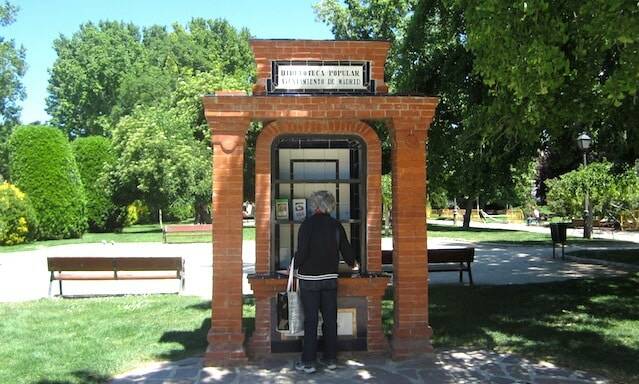 Public library in Retiro Park in Madrid (reference image)
Granada
Where the poetic heart beats
A land of borders and Andalusian charm, Granada breathes art in every nook. A city of ancient influences, its unique light, the constant presence of memory, and that atmosphere of suspended peace have turned this city into an essential muse for the greatest poets and thinkers. It is a place where the spirit, melancholy, and history intertwine in such a way that walking through its streets is, without a doubt, a pure act of creation.
Federico García Lorca (1898-1936)
He was the most influential and beloved poet of the 20th century in Spain. Born in Fuente Vaqueros, he highlighted the essence of Granada in his verses, mixing folklore, the "duende," and tragedy. His assassination at the beginning of the Civil War turned him into the eternal symbol of artistic freedom. He initially achieved fame with "Gypsy Ballads," a poetry collection that portrayed life in his native Andalusia. His poetry incorporated traditional Andalusian motifs and avant-garde styles.
Francisco Ayala (1906-2009)
He was a cosmopolitan intellectual and master of prose. In addition to being a great narrator, he was a brilliant essayist who never lost his connection to his native Granada despite exile. His analytical clarity and his ability to observe social change place him among the great thinkers of the last century. Among his best works are the novels "Death as a Way of Life" (*Muertes de perro*) and "The Bottom of the Glass" (*El fondo del vaso*), and his collections of stories "The Usurpers" (*Los usurpadores*) and "The Head of the Lamb" (*La cabeza del cordero*). After his return to Spain with democracy, he was recognized with, among others, the Cervantes Prize, the Prince of Asturias Award for Literature, and the National Narrative Prize.
Pedro Antonio de Alarcón (1833-1891)
He was a Spanish writer who belonged to literary realism and was born in the Granada town of Guadix. He began his career with a liberal, anti-clerical, and republican political stance, directing newspapers such as "El látigo" in Madrid. However, after participating in the War of Africa and a subsequent trip through Italy, he evolved towards conservatism and traditionalism. With his work "The Three-Cornered Hat" (*El sombrero de tres picos*), he managed to cross borders, showing the richness of Andalusian life. A fundamental voice for understanding the 19th century.
Recommendations for places to read peacefully:
Carmen de los Mártires, Generalife, Carmen of the Rodríguez Acosta Foundation, Federico García Lorca House Gardens, Placeta de los Carvajales.
 Gardens of the Federico García Lorca House (reference image)
Seville
Nostalgia of light
Seville is a city of timeless legend, a place where time seems to stand still to let its golden light shine. Among its orange trees and historic walls, Seville exudes a mixture of mystery, Baroque passion, and unique elegance. It is, above all, a city that inspires both desire and deep reflection, transforming its own history into a vibrant canvas that authors and poets have tried to capture with their hearts, making this city an eternal symbol of Andalusian beauty in the world.
Gustavo Adolfo Bécquer (1836-1870)
The soul of Spanish Romanticism. Despite a life marked by poverty and heartbreak in Madrid, his imagination was always anchored in the elegance and mystery of the Seville of his youth. The light, the Guadalquivir river, and the Sevillian tradition of popular legends permeated his sensitivity, granting him that mysticism and delicacy that define his style, making him the most read and cited poet of our language. His "Rhymes and Legends" are part of the sentimental education of generations, a collection of poems and stories that established him as the greatest exponent of Spanish Post-Romanticism.
Luis Cernuda (1902-1963)
An essential part of the Generation of '27, Luis Cernuda cultivated a poetry that oscillates between forbidden desire and overwhelming reality. In his work, Seville represents an inexhaustible source of light, but also of repulsion towards a conservative environment that pushed him into exile. His poetry collection "Reality and Desire" (*La realidad y el deseo*) is a raw testimony to his evolution, where Seville remains a memory of youth tinged with melancholy, a setting configured in his memory as a lost paradise of beauty and passion.
Antonio Machado (1875-1939)
Poet, playwright, and prose writer. Although his figure is usually inextricably linked to the sobriety of the Castilian lands, Antonio Machado was Sevillian by birth. He was born in the iconic Palacio de las Dueñas, a setting of courtyards and gardens that Machado would remember all his life in his most intimate verses: "My childhood are memories of a courtyard in Seville." This first Andalusian imprint laid the foundations for his deep and reflective voice, which would later become an emblem of 20th-century Spanish humanist thought. His most influential work was "Fields of Castile" (*Campos de Castilla*); in it, the author abandons the intimate modernism of his previous stage to focus on landscape description, social commitment, and existential reflection on Spain.
Recommendations for places to read peacefully:
María Luisa Park, Gardens of the Real Alcázar, Plaza de América, Andalusian Contemporary Art Center, Murillo Gardens
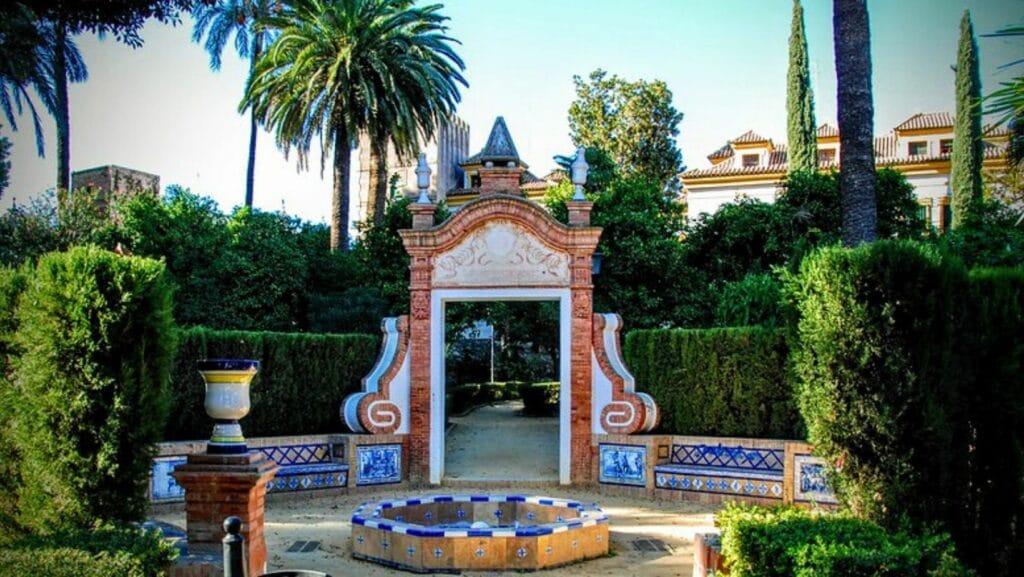 Murillo Gardens (reference image)
Share your favorite place to read by tagging U-Sense or For You Hostel, and win a free coffee: