Holy Week 2026 Guides
Seville Holy Week Guide 2026
The Holy Week in Seville is not simply a commemoration; it is a total metamorphosis of the city. During these days, the historic center becomes a living museum, a hotbed of devotion and aesthetics where time seems to stand still to the rhythm of bugles and drums. However, this unique experience requires a smart strategy to avoid getting trapped in the chaos. The key to enjoying this festivity to the fullest lies in an unnegotiable maxim: leave the car behind and understand the city through movement on foot and public transport.
Mobility Strategy
The biggest mistake as a visitor in Seville is trying to "do it all." During Holy Week, this city becomes a labyrinth where traffic collapses and distances multiply. It is highly recommended to plan by zones: choose a sector of the city (Center, Triana, or a historic neighborhood) and make it your epicenter for the day.
To reach these nerve centers, the Seville Metro is your best ally, remaining immune to the traffic closures that disable surface streets. If you opt for the city bus (TUSSAM), keep in mind that many regular stops change locations; the ideal is to get off at a peripheral stop and complete the route by walking. As for the car, the recommendation is definitive: make use of the deterrent parking lots, such as Blas Infante, and leave the vehicle far from the center. Attempting to access parking in the old town is an odyssey that rarely ends well due to closures and extremely high demand.
Unmissable Moments
Although the entire city breathes passion, there are encounters that define the essence of this week:
- La Madrugá: It is the most anticipated night. The atmosphere becomes electric and time seems to dilate. Seeing the float of the Gran Poder or the immensity of La Macarena is one of those experiences that, whether you are religious or not, leaves a lasting mark due to its emotional weight.
- The Jewels of Monday and Tuesday: The Brotherhood of Santa Marta stands out for the perfection of its sculptural ensemble, which looks like a Velázquez painting coming to life. On the other hand, the sobriety and elegance of the Estudiantes make Holy Tuesday a day of singular aesthetic beauty.
- The Triana of Thursday: Watching the Esperanza de Triana cross the old bridge that connects the neighborhood with the center is a scene that summarizes the soul of the Guadalquivir.
- Mastery of the Beginning: On Palm Sunday, the Brotherhood of La Paz floods the streets with an atmosphere of hope that marks the perfect starting point for any visitor.
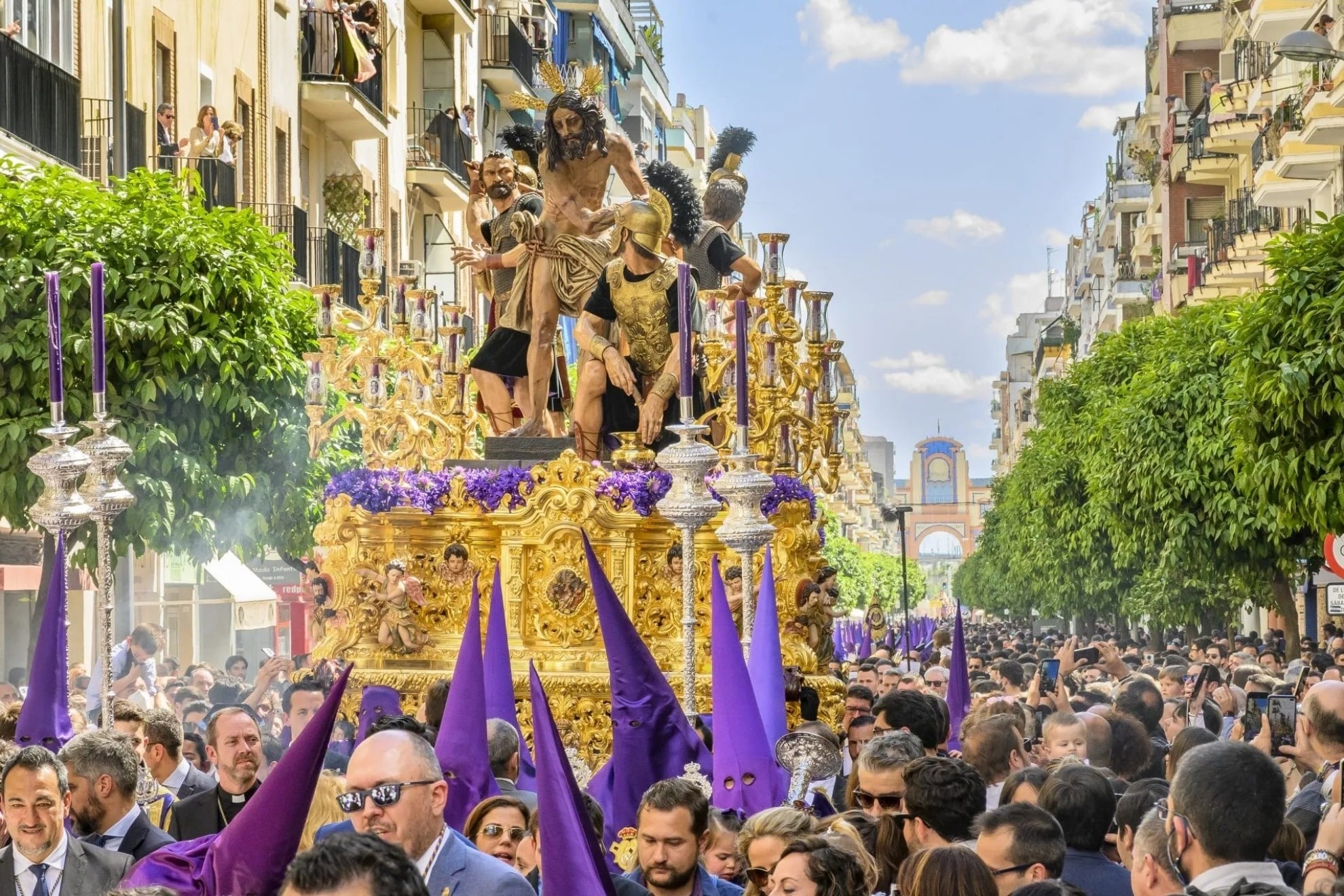
 Seville's La Madrugá (reference image)
Routes with local flavor
Seville's La Madrugá (reference image)
Routes with local flavor
If you are looking for a more authentic experience away from the pressure of the official route, we encourage you to Search for your own "silence routes":
- Search for the Eves: If you arrive before Palm Sunday, do not miss the neighborhood atmosphere of brotherhoods like Pino Montano or La Milagrosa. It is here that you will discover the most hospitable and intimate side of the festival.
- The charm of the river: Walking along the Paseo Colón while watching brotherhoods pass with the river horizon as a backdrop is a winning bet, both for the aesthetics and the fluidity of the avenues.
- Plazas as lungs: If the street becomes narrow and you feel the agony of the crowd, head towards the Alameda de Hércules or the Plaza del Salvador. They are wide spaces where, in addition to breathing, you will be able to see the floats with a much more comfortable and less suffocating perspective.
Recommendations for a serene stay
For the experience to be fully enjoyable, especially if you are traveling with family or have any mobility limitations, keep these tips in mind:
1. Prioritize quality over quantity: It is better to follow a single brotherhood for its entire day than to try to see five and end up exhausted.
2. Technology serving tradition: Rely on official applications to follow itineraries in real-time; unexpected roadworks or weather conditions may force brotherhoods to vary their routes at the last minute.
3. The "gift of patience": If you get caught in the middle of a crowd, do not try to fight against it. Head to a side street, take a break, and when your pulse returns to normal, resume your path.
The Holy Week of Seville is, above all, an exercise in letting yourself go. Sometimes, the best route is not the one that appears on Google, but the one you find by chance when the sound of a brass band warns you that Seville is celebrating its faith and its history.
Granada Holy Week Guide 2026
Granada transforms into a stage of shadows and lights where the floats seem to float along the slopes of the Albaicín or the Realejo. To enjoy this experience to the fullest, the visitor must understand that here geography is the protagonist. This city requires a slow pace and planning that takes into account that the center is a pedestrian museum.
The art of traversing slopes
Unlike other cities, in Granada, mobility is dictated by its irregular topography. The main advice is clear: forget about the car. Trying to move by private car through the narrow and steep streets of Granada during Holy Week is a perfect recipe for stress.
The city buses (which cover key points such as Gran Vía, Reyes Católicos, and the surroundings of the Albaicín) are your best option. However, remember that their capacity and route may be altered by brotherhoods.
Granada is explored on foot. Prepare for the slopes; comfortable and ergonomic footwear is the most important piece of your luggage. If you come from outside, the most effective thing is to park in the peripheral or business center parking lots and integrate into the city by getting around on foot. The historic center of Granada was designed for pedestrians centuries ago; during Holy Week, this nature is accentuated.
Moments that define Granada's Holy Week
Granada offers scenes that look like they were taken from a painting. In this city, the intensity does not reside in the crowd, but in the surroundings:
- The Cristo de los Gitanos (Holy Wednesday): It is the pinnacle moment. Watching this float descend through the Sacromonte, with the bonfires lit illuminating the caves and the echo of flamenco singing in the darkness, is one of the most overwhelming experiences one can have in Spain.
- The Silence (Maundy Thursday): The Cristo de la Misericordia, traveling along the Carrera del Darro in total silence under the shadow of the Alhambra, is the epitome of Granada's sobriety.
- The Alhambra and the Nazarenes: On the days of Maundy Thursday and Good Friday, seeing any brotherhood processing with the silhouette of the Alhambra in the background or the palaces of the Carrera del Darro is an unparalleled artistic framework.
- The Humildad (Aurora): The departure from the Albaicín is one of the most beautiful moments due to the complexity of the route and the proximity of the public.
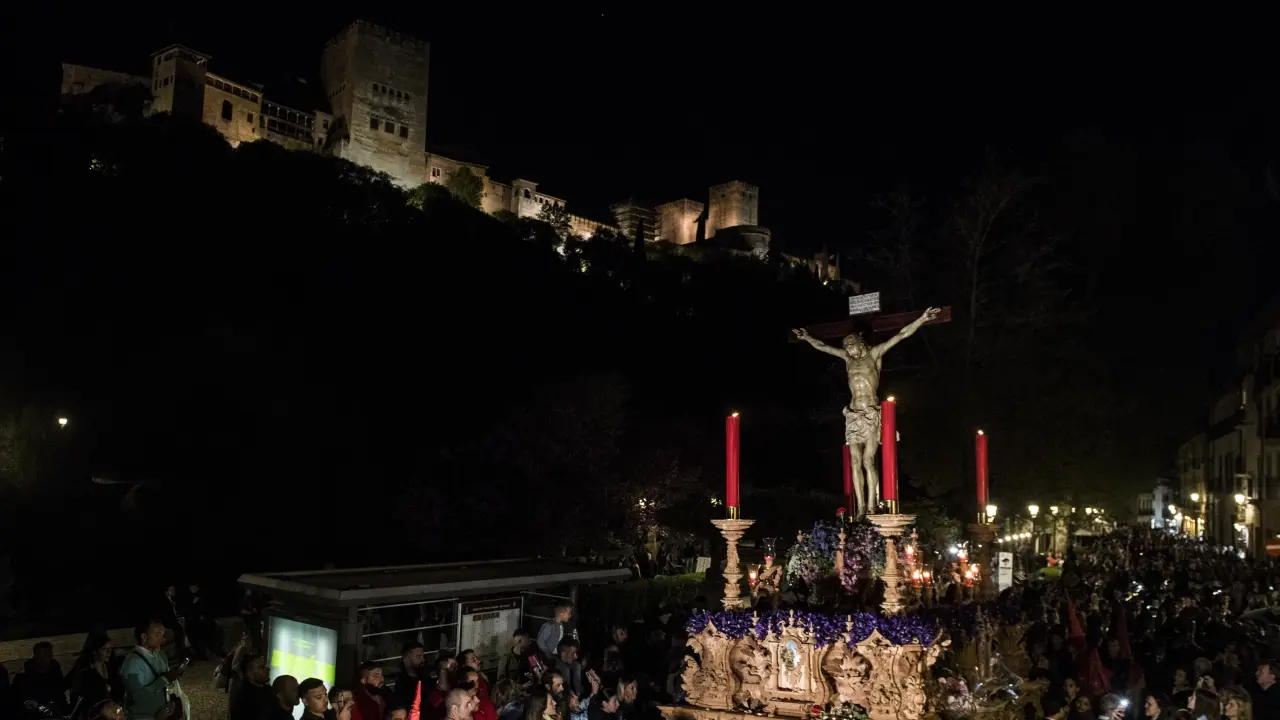 The Cristo de los Gitanos of Granada (reference image)
Routes to feel the city
The Cristo de los Gitanos of Granada (reference image)
Routes to feel the city
Granada allows you to experience Holy Week from different perspectives, each more suggestive than the last:
- Darro and Albaicín route: It is a historic route. Walking along the Carrera del Darro watching the brotherhoods pass reflecting in the riverbed, flanked by stately buildings, is a living lesson in history and devotion.
- Realejo route: The old Jewish quarter. Its narrow streets give the processions a more intimate air. It is ideal for seeing less crowded brotherhoods, but with a fascinating artistic and ritual weight.
- The San Nicolás viewpoint: Although it is not a procession point itself, during this week the atmosphere in the Albaicín is unique. Many brotherhoods go up to the neighborhood, allowing you to see the float while the sun sets over the Alhambra.
Recommendations for a serene stay:
1. Less is more: Just like in Seville, Granada gets saturated at the points of the Official Route (the Cathedral area). It is better to opt for the outward or return journey, which is where you will really enjoy the walking of the float and the prayer of the brother.
2. The weather is variable: Granada in Holy Week can be treacherous. During the day you can feel a warm sun, but at nightfall, especially in the Albaicín or the Sacromonte, it cools down considerably.
3. Cofrade App: Use local applications or the official website of the Brotherhood Federation. In addition, this city has a very particular style of processing: the "pulse" and the "levantá" are moments of absolute silence here, unlike in other cities. Therefore, be respectful of these gestures of withdrawal.
4. Andalusian rhythm: Granada is a city to get lost in. If you meet a brotherhood, let it guide you. Often, the most beautiful moment of your Holy Week in Granada will not be the one you planned, but the one you found by chance in a small alley where only the float and you fit.
You may also be interested in this article
Recommendations for the Andalusian Holy Week