
Updating to continue with your booking

Based on the account of José A. Salazar Murillo
Seville is a city made of layers, where the present walks upon the echoes of past centuries. To reach our hostel, you must enter Calle de Bailén, a winding and narrow path whose layout is the most broken and character-filled in the city center. There, specifically at number 15, where a plastic plaque today informs about our tourism business, years ago another plaque announced the life and work of the Murillo family.
Today, these walls are home to countless travelers from all over the world; but in the past, they were the convent, the medical office, and the epicenter of a family that, for decades, made this building a universe.
Our building was not designed all at once; rather, it grew little by little over time. Its uneven levels, those marble stairs that we have smoothed out today to make it easier for your suitcases, are the remains of its convent past. What are now modern rooms, coworking areas, and a patio full of optimism were, for decades, the epicenter of the Murillo family. That large house, which before being a home was a convent, housed not only medical consultations and the laughter of dozens of cousins running through its corridors, but also a liturgy of daily rituals.
Those who inhabited these walls left an invisible but indelible trail. The “putódormo” (the room where the young people fooled around and dreamed), the luxurious player piano that brought the airs of zarzuela to the dimly lit living room, and the thousands of steps that marked the different levels of the old convent have not disappeared; they have simply changed shape to adapt to new times.
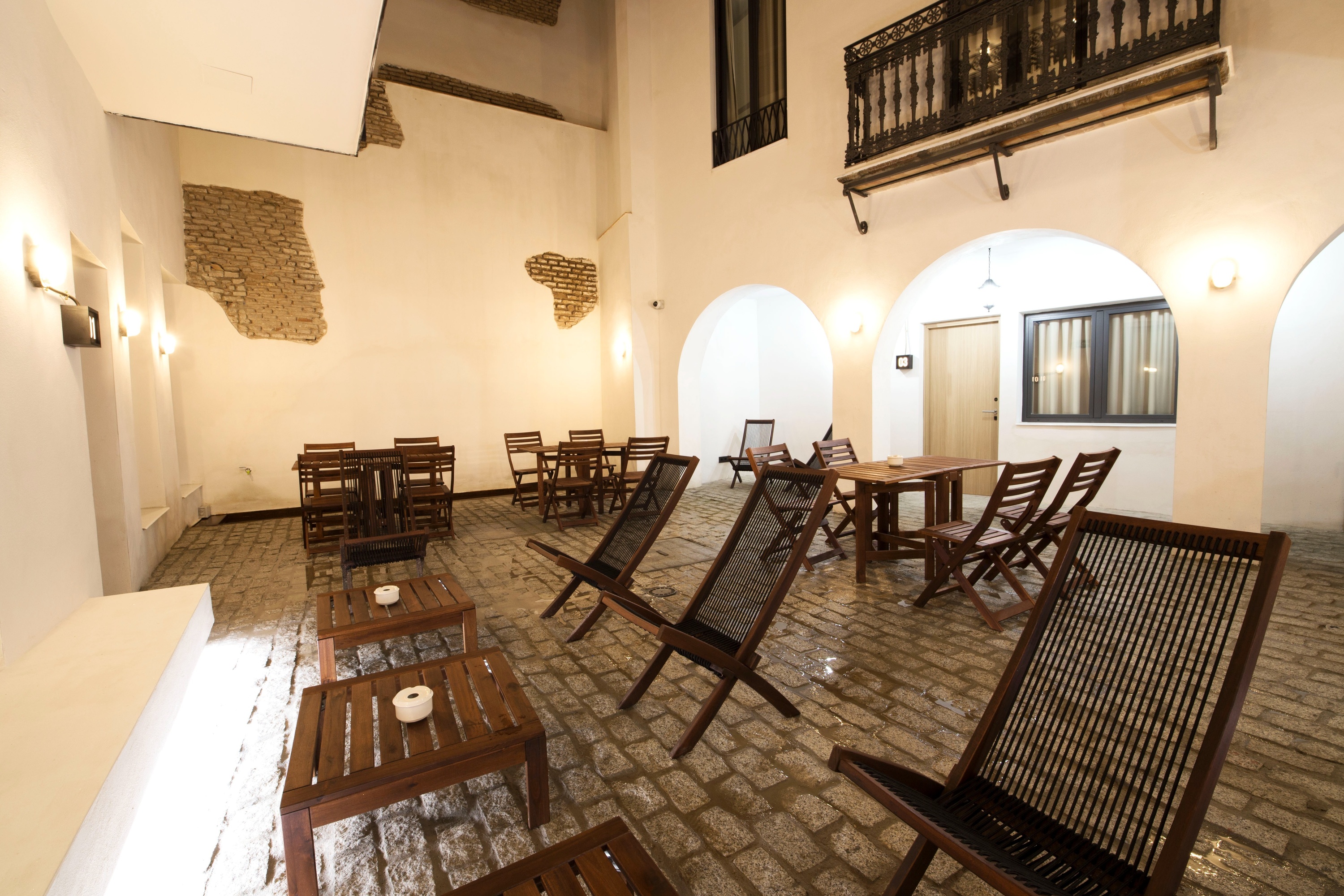
The central patio of Bailén 15 was not always a functional reception area. In its heyday, it served as the heart of the house. The pilasters and ferns formed an ecosystem that, during frequent Sevillian rains, transformed the patio into a natural auditorium, where the impact of the drops on the wide leaves created an improvised acoustics.
Hidden in this patio were also rooms of vital social importance, such as the corner now occupied by the management office, which in its day was the meeting center for the family's youth. The constant changes in level, the historic steps, and the wrought-iron gate were the filters that separated the bustle of Calle Bailén from domestic intimacy. Today, although the furniture and signage have adopted a youthful and functional environment, the patio maintains its essence as a place of transit and meeting, preserving the structure that organized the lives of its inhabitants for decades.
The first floor of the building houses a type of living room that is now in disuse. It was a space of permanent, almost liturgical gloom, whose main axis was a player piano, a mechanical piano that allowed for a sophisticated auditory experience, and a display case that guarded the memories of family expeditions to the Vatican or Lourdes. This living room, decorated with mirror furniture and heavy curtains, functioned as a sanctuary against the outside reality of the Seville of that era.
The current redistribution of space has fragmented this large living room into private compartments for guests, optimizing the property's capacity. However, the ceiling structure and the flow of the corridors still retain the original layout, allowing the majesty of the marble staircase to remain the mandatory passage that connects the ground floor with the memory of those musical evenings.
The internal functioning of the old house was a mixture of ingenuity and tradition. Notable are the systems devised for household management, such as the complex mechanism of cables and springs that allowed the gate to be opened from the first floor, a task usually entrusted to the family's grandchildren. Life inside took place between the figure of the grandparents, their hobbies like stamp collecting and card games, and domestic staff who managed everything from the supply of local sweets to the care of the house. Also, Don Murillo recalls with joy the privilege of opening the iron gate from the first floor using an ingenious system of cables and springs. That was his small power.
That family intimacy, marked by religion and the administration of assets, constitutes today a testimony to the domestic customs of mid-20th-century Seville. A journey into the grandparents' intimacy.
Today, the metallic sound of the old gate has been replaced by the welcome of our reception, and where Dr. Murillo used to sit to play his solitaires, we have now installed collective workspaces and reading areas for you. We are fully aware that our hostel has transformed those spaces, turning the grand stately rooms into practical and modern bedrooms for travelers wandering through our city.
Each guest who checks in at our counter today is not a stranger, but another user of a cycle that began more than a century ago. By sleeping here, you are sleeping in the rooms that were once sanctuaries of music, family birthing rooms, or the offices of eminent doctors. The next time you walk up our marble staircase or relax in our patio, remember that you are sharing space with the memories of a family that loved, suffered, and lived every corner of this house intensely. The house is ready for your story.